Wall Street Spent a Decade Saying No to Bitcoin, Then Took $91 Billion of It
After a decade of rejections, Wall Street got its Bitcoin fund. $91.8 billion in assets and counting.
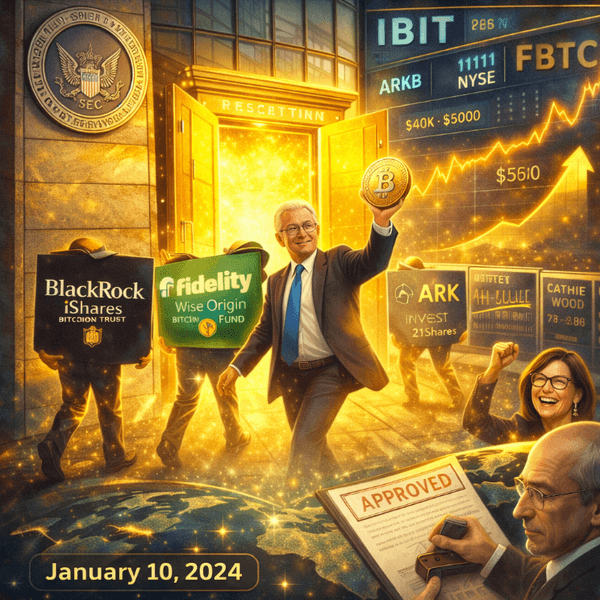
On January 10, 2024, the SEC approved 11 spot Bitcoin ETFs simultaneously. It was the most anticipated regulatory decision in crypto history. The Winklevoss twins had first applied for a Bitcoin ETF in 2013. It took over a decade of rejections, lawsuits, and lobbying to get to yes.
The approval was transformative. For the first time, ordinary investors could buy Bitcoin exposure through their existing brokerage accounts, IRAs, and 401(k)s. No wallets, no exchanges, no private keys. Just a ticker symbol. Your grandmother could now have Bitcoin in her retirement account without knowing what a blockchain is.
BlackRock's iShares Bitcoin Trust (IBIT) became the fastest-growing ETF in history, reaching $10 billion in assets faster than any ETF before it. By March 2026, IBIT alone holds approximately $76 billion - making it the dominant product in the category. Total US spot Bitcoin ETF assets sit at roughly $91.8 billion.
Bitcoin's price responded. From roughly $46,000 at approval, BTC climbed past $100,000 within the year. The ETFs created a structural bid: every day, as new money flows in, the ETF managers must buy actual Bitcoin on the open market. Steady, daily, institutional buying pressure that did not exist before January 2024.
The ETF approval also changed Bitcoin's character. It became a mainstream financial product. The same firms that had dismissed Bitcoin for years - BlackRock, Fidelity, Franklin Templeton, Invesco - were now its biggest promoters. Larry Fink, BlackRock's CEO, went from calling Bitcoin "an index of money laundering" in 2017 to calling it "digital gold" in 2024. The revolution was being packaged and sold by the institutions it was meant to disrupt.
The approval also brought a new risk: correlation. Bitcoin ETFs move with stock market sentiment. When the S&P 500 sells off, Bitcoin ETFs see outflows. The asset that was supposed to be uncorrelated to traditional finance is now literally traded on the same platforms, by the same people, with the same algorithms. Independence came at the cost of independence.
The Aftermath
Spot Bitcoin ETFs hold $91.8B in assets as of March 2026. BlackRock IBIT dominates with ~$76B. The ETFs created daily institutional buying pressure and accelerated mainstream adoption. They also introduced new correlation risk with traditional markets.
COMMENTS