Mint Blockchain: The NFT-First Layer 2 That Ran Out of NFTs
An Ethereum L2 built specifically for the NFT ecosystem. Launched at the peak of the NFT hype. Closed when the hype was gone. Users had six months to bridge out.
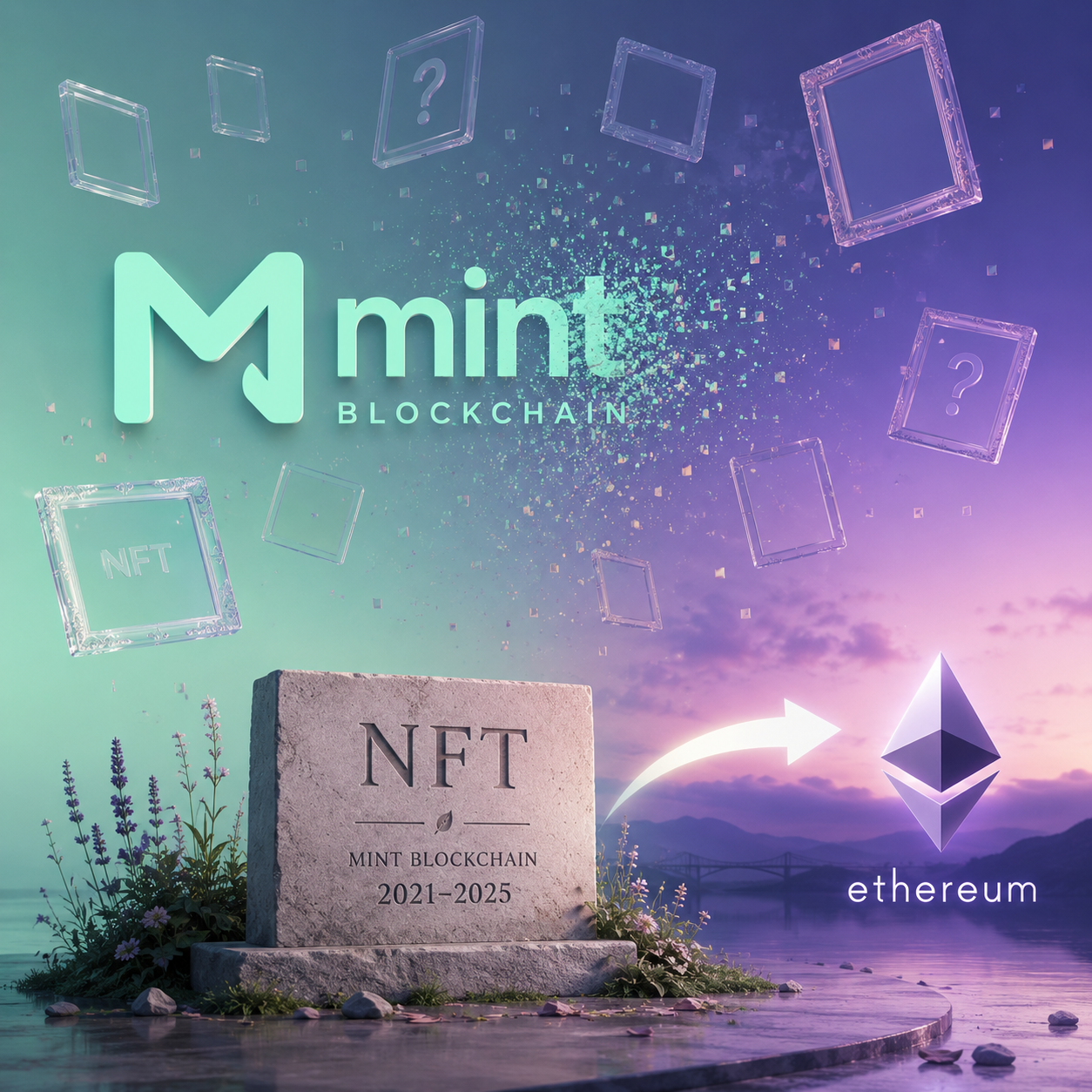
On April 17, 2026, Mint Blockchain announced it was ceasing operations. The Ethereum Layer 2 chain, built specifically as an NFT-focused infrastructure platform, gave its users until October 20, 2026 to bridge their assets back to Ethereum mainnet. After that deadline, the project warned, the funds "will not be available for processing." Mint Blockchain joined the long list of projects that launched into the NFT mania of 2021-2022, expanded through the 2024 brief revival, and quietly closed when the underlying narrative no longer existed.
Mint Blockchain belonged to a category of Layer 2 chains that built their identity around a specific use case rather than general-purpose Ethereum scaling. The pitch was simple. Ethereum was expensive for NFT minting and trading. Generic L2s like Optimism and Arbitrum were cheaper but were optimized for DeFi flow rather than NFT flow. Mint Blockchain offered NFT-specific infrastructure: native tooling for creators, integrations with NFT marketplaces, gas optimizations for batch minting, and a community-building approach focused on artists and collectors. For a brief window in 2024, the thesis seemed viable.
The thesis required NFTs to remain a meaningful market. They did not. Total NFT trading volumes, which peaked at over $17 billion monthly in January 2022, fell catastrophically through 2022 and 2023, recovered modestly in 2024, then resumed declining through 2025 into 2026. By the time Mint Blockchain announced its closure, monthly NFT volumes had collapsed roughly 95 percent from their peak. The number of active wallets transacting in NFTs had shrunk by a similar magnitude. Most of the speculative pull of the 2021 era had simply evaporated.
Mint Blockchain's announcement framed the shutdown in restrained terms. The team said the project's continued operation no longer aligned with its strategic priorities. Users were directed to bridge assets - ETH, WBTC, USDC, and USDT - back to Ethereum mainnet within the six-month window. Bridging was free for the affected currencies, and the team published guides explaining the migration steps. The infrastructure for orderly user withdrawal was in place. What was not in place was a future for the chain itself.
The structure of the wind-down resembled the orderly Bit.com shutdown more than the catastrophic NFT-platform exits of earlier years. SuperRare, the NFT-focused art platform whose 2021 peak prices became defining moments of that cycle, did not exit cleanly when its own market collapsed - many users found themselves holding artwork on a platform they could not realistically sell out of. Mint Blockchain's withdrawal-window approach was more user-friendly. The October 20, 2026 deadline gave even slow users six months to act. The technical infrastructure for bridging out was maintained until close.
Still, the structural reality of the closure was harsh for users who had built workflows around Mint. Creators who minted collections on the chain faced a decision: bridge core assets out and let their NFT collections become orphaned, or continue trying to maintain the collections on a chain that would soon be operationally dark. Most chose the former. The NFT-specific assets - the actual JPEGs and metadata pointers - exist on Mint's contracts and IPFS storage. With the chain ceasing operations, the smart-contract layer those NFTs depend on becomes an open question. IPFS pointers may persist if pinned by third-party services. The contracts themselves will exist on whatever historical archive of the chain remains. But active functionality - secondary sales, royalty distribution, metadata updates - effectively ends.
Mint Blockchain's shutdown is part of a broader trend that started in late 2024 and accelerated through 2025-2026. Specialized L2s that targeted single use cases have largely failed to maintain meaningful activity. Gaming-focused chains, prediction-market chains, and several social-graph chains have either shut down, pivoted, or quietly stopped marketing. The general-purpose L2 incumbents - Arbitrum, Optimism, Base, Polygon - captured the bulk of the activity that single-purpose chains had originally tried to differentiate against.
The economics of NFT-specific infrastructure are particularly punishing. NFT trading is highly cyclical, with volume concentrated in brief speculative bursts. Sustainable infrastructure requires baseline transaction volumes that NFT-only flows simply do not provide outside of cycle peaks. Even during 2024's modest revival, the activity did not approach what 2021 had suggested would become normal. The narrative that NFTs would become the primary use case of Ethereum, which justified building Mint Blockchain in the first place, was gone by 2023. The decision to keep the project running for two more years was patience. The decision to close in 2026 was acknowledgment.
For the broader Mint ecosystem - the NFT collections, the marketplace integrations, the art communities that had developed around the chain - the shutdown is a quiet end. Some collections will migrate to other chains. Some will be abandoned. Some communities will dissolve. The artworks themselves remain digital files. Whether they continue to function as transferable, salable, royalty-bearing assets depends on third-party preservation efforts and what Mint Blockchain's residual smart contracts will support.
The graveyard verdict on Mint Blockchain is mild. It did not steal user funds. It did not collapse in scandal. It did not leave a trail of indictments. It launched into a narrative that was already past its peak, executed reasonably, and closed when the math no longer worked. The orderly shutdown distinguishes it from the worst exits in this section. The fact that it joined this section anyway is the signal. The NFT-as-primary-use-case-of-Ethereum thesis is dead. The infrastructure built around it is, one closure at a time, being decommissioned.
The Aftermath
Withdrawal window runs until October 20, 2026. Most users with major asset holdings (ETH, WBTC, USDC, USDT) can bridge out cleanly. NFT collections minted on Mint Blockchain face an uncertain future - smart-contract functionality ends with the chain, though IPFS metadata may persist if pinned by third parties. The closure is orderly and not associated with fraud or theft, distinguishing it from worse exits in the graveyard. The thesis behind the project - NFTs as primary Ethereum use case - is dead.
COMMENTS