'Liquid Restaking': The Yield Narrative That Lost Its Backing
EigenLayer was the future of Ethereum yield. LRTs were how everyone would access it. Then Kelp DAO lost 18% of its supply in two hours and the thesis stopped making sense.
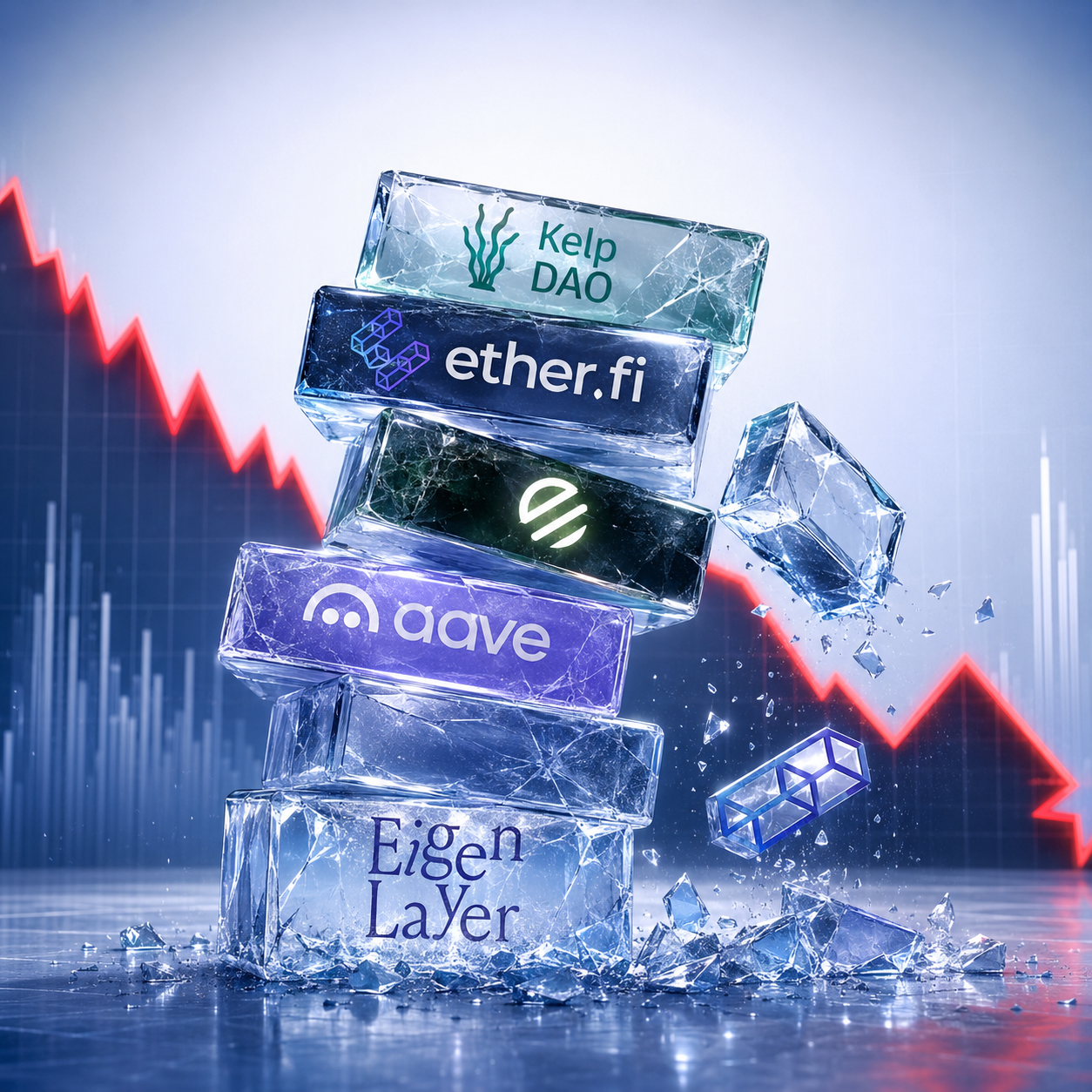
For roughly two years, liquid restaking was the most confidently pitched yield narrative in DeFi. The story: stake ETH on the consensus layer, restake it on EigenLayer to secure additional services, receive an LRT token like rsETH or weETH or ezETH that represents your position, and use that token as collateral elsewhere in DeFi to compound yields further. Three layers of yield. One token. Liquidity at every step. By mid-2024, the total value locked across LRT protocols had pushed past $22 billion. The thesis was the hottest in DeFi.
On April 18, 2026, an attacker stole 116,500 rsETH from Kelp DAO worth $292 million. That was 18 percent of the entire circulating supply of one of the largest LRTs. In two hours, the underlying assumption of the entire liquid restaking architecture - that the bridge contracts holding the underlying ETH would not break - was disproved on the most public possible stage. Aave, Spark, and Fluid froze rsETH markets across more than 20 chains. The peg cracked. A $9 billion panic withdrawal followed. The thesis did not recover.
The liquid restaking pitch had been seductive for the same reason most failed DeFi narratives are seductive. It promised compound yield through additional security layers without requiring the user to take on operational complexity. Stake ETH for ~3 percent. Restake on EigenLayer for additional points and eventual operator yields. Wrap into an LRT for full liquidity. Use the LRT as collateral on Aave to borrow stablecoins. Use the stablecoins to amplify positions or provide additional liquidity. Each layer was supposedly only marginally riskier than the layer below, and the cumulative yield could compound to double-digit annualized returns on what users still framed as ETH-equivalent exposure.
The framing mostly worked because the rewards were partially in EigenLayer points, which had no spot market until 2024 and remained difficult to value even after they did. Users were earning yields whose dollar equivalents were obscured by the points-economy structure. When EigenLayer eventually launched its EIGEN token and the points started settling, the actual realized yields turned out to be considerably less impressive than the marketing implied. Several large LRT protocols saw substantial outflows during 2024-2025 as users discovered that the actual income was a fraction of the headline numbers.
That alone would not have killed the thesis. Many DeFi narratives recover from disappointing yields if the underlying mechanics still work. The Kelp DAO hack changed the conversation because it broke the underlying mechanics, not the yields. The attacker did not exploit a flash-loan vulnerability or arbitrage a price oracle. They spoofed a LayerZero cross-chain message that the bridge contract was supposed to verify, and they got the bridge to release ETH to an address it should not have. That is a fundamental break in the architecture LRTs depend on.
When the rsETH peg cracked in the immediate aftermath, every protocol holding rsETH as collateral had a problem. Aave's exposure was nearly $200 million against an insurance fund of roughly $80-100 million. Lenders raced for the exits across Aave, SparkLend, and Fluid. Stablecoin DeFi rates spiked to 10 percent overnight as supply collapsed. The contagion was the same one Curve had narrowly avoided in 2023 - a major asset losing peg, the lending platforms holding it as collateral becoming undercollateralized, and a panic among lenders trying to extract dollars before the math caught them.
The reaction across the LRT ecosystem was rapid and grim. ezETH and weETH both saw substantial outflows the same week, even though their bridges had not been compromised. The market did not distinguish between the affected LRT and others - it priced in the possibility that any LRT could be next. Several mid-tier LRT protocols saw their TVL fall 30-50 percent in a single week. The category had previously been the most vibrant on DeFiLlama. By early May, it was one of the slowest.
The deeper problem is that the LRT thesis was always implicitly bundling three risks that the marketing had pretended to separate. There was the slashing risk of the underlying restaking - the chance that a misbehaving operator would cost the staker actual ETH. There was the smart-contract risk of the LRT protocol itself - bugs, admin keys, governance attacks. And there was the bridge risk, which most users had not been thinking about because the bridge logic was abstracted behind the LRT contract. Kelp DAO surfaced the third risk in the most expensive way possible.
EigenLayer itself, the foundational layer the LRT thesis depended on, has continued operating. The protocol's design separates restaking commitment from token issuance, and the EIGEN token has a different risk profile than the LRTs built on top. But the LRT layer specifically has lost its central place in DeFi storytelling. The narrative that drove tens of billions in TVL through 2024 has, by mid-2026, become one of the bear-market casualties of the cycle.
Most LRT protocols are still operational. Kelp DAO itself is technically running, though rsETH still trades below peg on multiple chains. ezETH and weETH still exist and have user bases. The category has not collapsed entirely. What has collapsed is the confidence that LRTs are a default building block of DeFi yield strategies. Lenders reduced exposure. Yield farmers rotated to other strategies. Protocol developers stopped framing new products around LRT collateral.
This is what dead narratives look like in DeFi. They do not fully disappear. They become smaller and more carefully bounded. They lose the casual default-trust they had during peak narrative. They become things sophisticated users continue to engage with under specific conditions, rather than things every retail user is told they should hold. The LRT category had been the latter. By April 2026, it was the former. That is what the Kelp DAO hack actually did. It moved liquid restaking from default to specialty.
The Aftermath
LRT TVL collapsed sharply through April-May 2026. Aave, Spark, and Fluid kept rsETH markets frozen across 20+ chains for weeks after the hack. EigenLayer itself continues operating. LRT protocols including Kelp DAO, EtherFi, and Renzo are still running but with substantially smaller TVL and reduced market trust. The yield narrative that drove the category through 2024 is gone. LRTs have moved from default DeFi building block to specialty asset.
COMMENTS