'NFTs Will Tokenize Everything': They Didn't
Bored Apes sold for $400K. Now the floor is $12,500. OpenSea went from $13.3B valuation to layoffs. The JPEGs lost.
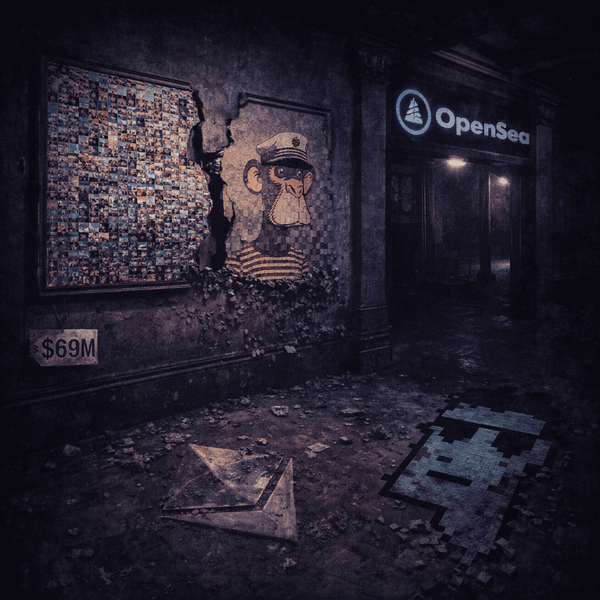
In 2021, Beeple sold an NFT for $69 million at Christie's. That single auction convinced millions of people that digital art was the future. Profile picture (PFP) projects exploded. Bored Ape Yacht Club floor prices hit 145 ETH - over $400,000 per ape. CryptoPunks sold for millions. Everyone was a collector. Everyone was a genius.
The narrative expanded: NFTs would tokenize everything. Real estate. Music royalties. Event tickets. Medical records. Gaming items. The technology was not just for art. It was the infrastructure for a new ownership economy. Every conference had an NFT track. Every brand launched a collection.
At its peak in January 2022, NFT trading volume hit $5.4 billion in a single month. Celebrities launched collections. Brands created digital wearables. Twitter added NFT profile pictures. It felt like the world was shifting.
Then the bear market arrived. NFT volume collapsed 97% from peak. Bored Ape Yacht Club floor prices crashed from 145 ETH to roughly 5.4 ETH by March 2026 - a 96% decline in ETH terms, worth about $12,500. Most PFP projects went to zero. The thousands of "utility" NFTs that promised roadmaps and community benefits delivered nothing. A study found 95% of NFT collections had a market cap of zero.
OpenSea, once valued at $13.3 billion after its January 2022 funding round, cut 20% of staff in July 2022, then another 50% in November 2023. Investor markdowns implied a valuation around $1.4 billion - an 89% haircut. The company pivoted to become a broader crypto trading aggregator, reportedly handling $1.6 billion in crypto trades in early October 2025. It survived, but not as an NFT marketplace.
The "tokenize everything" dream was even more thoroughly destroyed. No meaningful real-world asset tokenization happened through NFTs. High gas fees, poor UX, and lack of legal frameworks made real-world adoption impractical. The technology's most enthusiastic use case turned out to be speculating on monkey pictures.
What survived was small and specific: digital collectibles for dedicated communities, on-chain generative art, and some gaming items. The $5.4 billion monthly market became a niche. NFTs found their place. It was a corner of the internet, not the foundation of a new economy.
The Aftermath
BAYC floor crashed 96% from 145 ETH to ~5.4 ETH. OpenSea's implied valuation fell from $13.3B to ~$1.4B after layoffs. The 'tokenize everything' narrative is dead. NFTs survive as a niche for collectors and generative art.
COMMENTS