Phishing: One Click and Your Wallet Is Gone
The attacker doesn't hack the code. They hack you. $494 million stolen in 2024 alone.
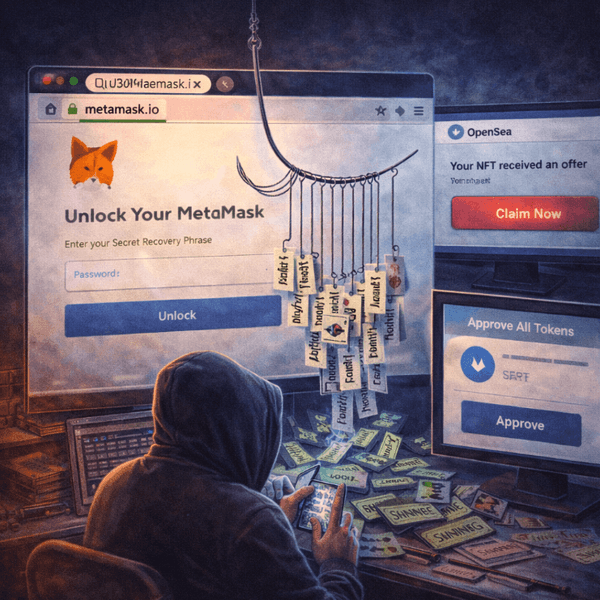
Phishing is the most effective attack in crypto because it targets the weakest link: the human. No smart contract exploit needed. No billion-dollar flash loan. Just a fake website, a convincing email, or a well-timed DM. One wrong click and everything in your wallet is gone. Irreversibly.
The most common phishing method is fake websites. A scammer creates a pixel-perfect copy of MetaMask, Uniswap, or OpenSea with a slightly different URL - m3tamask.io instead of metamask.io. You connect your wallet. You approve a transaction. Your assets are drained. The approval was a token allowance that gave the attacker unlimited permission to move everything you own.
Social engineering is the sophisticated version. Scammers pose as support agents on Discord, customer service reps on Twitter, or potential employers on LinkedIn. They build trust before asking you to connect a wallet, share a screen, or click a link. The Ronin Bridge hack - $624 million stolen by North Korea's Lazarus Group - started with a fake job offer sent to a Sky Mavis engineer on LinkedIn. One employee clicked. $624 million gone.
Seed phrase phishing remains depressingly effective. "Enter your 12-word recovery phrase to verify your wallet." No legitimate service will ever ask for this. Yet thousands of people enter their seed phrases into fake forms every month. Once entered, automated bots drain the wallet within seconds. Not minutes. Seconds.
The good news: phishing is getting harder. Scam Sniffer's 2025 annual report showed that wallet drainer phishing losses dropped 83% to approximately $84 million, down from $494 million in 2024. Victims fell by 68% to about 106,000. Better wallet warnings, browser protections, and user education are working. But $84 million is still $84 million.
Hardware wallets protect against most phishing attacks but not all. If you sign a malicious transaction on a hardware wallet, the hardware cannot save you from your own decision. The best defense is slowness. Never click links from DMs. Never approve transactions you did not initiate. Never rush. Speed is the scammer's best friend and your worst enemy.
The Aftermath
Phishing losses dropped 83% in 2025 to $84M (from $494M in 2024), but broader crypto fraud is still enormous - Chainalysis estimated $17B in scams for 2025. Wallet security is improving, but the human remains the weakest link.
COMMENTS