Polymarket's Dirty Secret: How Whales Rig the 'Truth Machine'
The world's biggest prediction market lets anonymous whales vote on what really happened. They've been voting for profit, not truth. Seven times and counting.
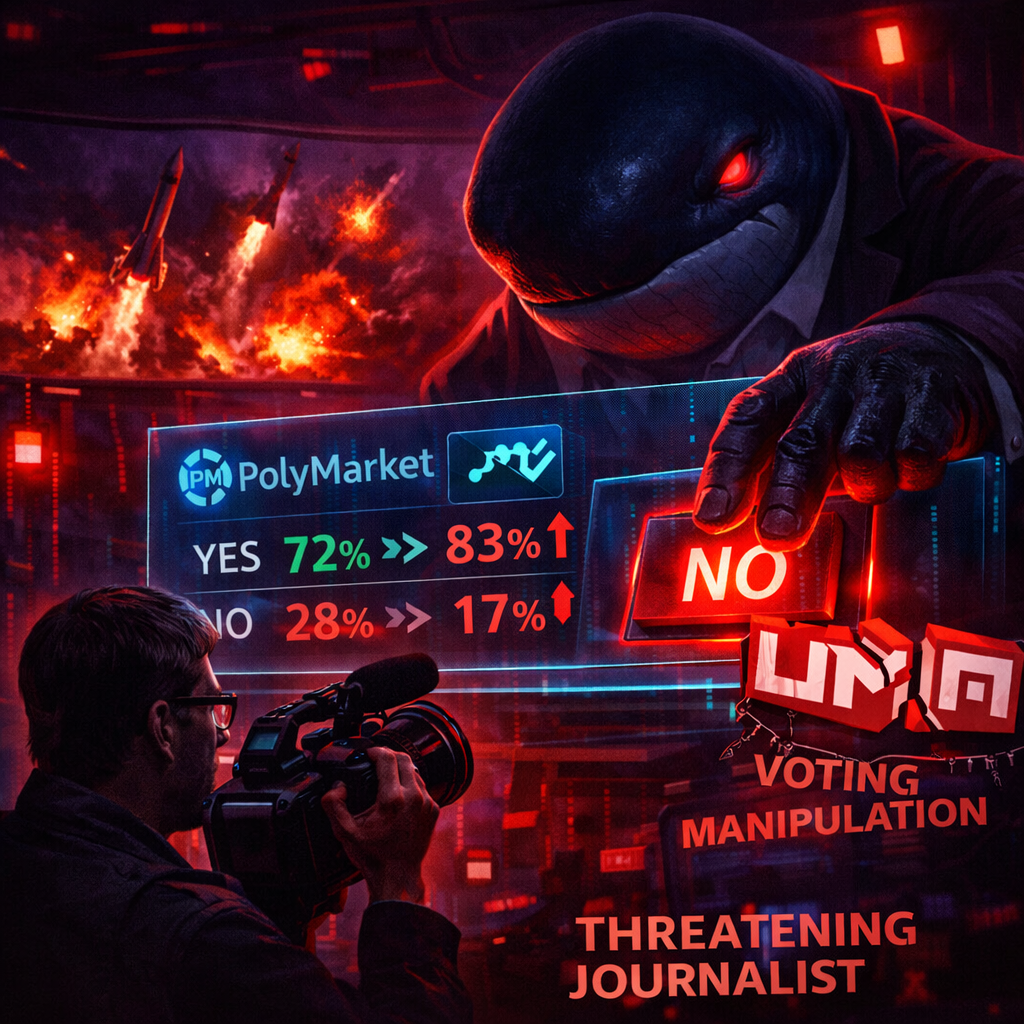
Polymarket calls itself a truth machine. Over $15 billion in lifetime volume. Tens of millions of users. Bloomberg covers it. The White House talks about it. The pitch sounds bulletproof: decentralized markets find truth faster than journalists, governments, or experts ever could.
One problem. The truth is decided by a vote. And the vote can be bought.
THE ORACLE NOBODY AUDITS
Polymarket doesn't decide its own market outcomes. It outsources that job to an external system called UMA - Universal Market Access - a so-called "optimistic oracle." Here's how it works. When a market closes, anyone can propose a result by staking a small bond, usually $750 in USDC. If nobody disputes the proposal within a challenge window, the result stands. If someone challenges it, the dispute goes to a vote by UMA token holders. Whoever holds the most UMA tokens controls the outcome.
Read that again. The entire system - billions of dollars in bets across thousands of markets - is governed by a token with a total market capitalization of roughly $95 million.
That is not a typo. A $95 million token decides the outcome of $15 billion in bets. Individual Polymarket markets have exceeded $200 million in volume. More than double the value of the oracle that governs them. The Zelenskyy suit market alone had $237 million wagered. The Iran war markets collectively exceeded $529 million. Every single one of these bets was ultimately decided by UMA token holders. Community analysis has found just two wallet addresses control over 50% of all voting power.
The math of the exploit is simple enough for a child. If you hold enough UMA tokens to control a vote, and you also hold a position on the Polymarket market that vote governs, you vote for the outcome that makes your bet win. Doesn't matter what actually happened. The profit from winning the bet exceeds the cost of the tokens. The penalty for voting dishonestly? A small slash of your UMA stake. Pennies compared to millions at stake.
This is not theoretical. It has been exploited at least seven times. Each time bigger than the last.
THE WHALE PLAYBOOK
Every confirmed manipulation follows the same five steps.
Step one. A whale finds a market with subjective or ambiguous resolution criteria. Markets asking "Did X happen?" where "X" requires interpretation are the prime targets. "Did Zelenskyy wear a suit?" needs someone to define what a suit is. "Did Iran strike Israel?" needs someone to determine whether an intercepted missile counts. The ambiguity is the attack surface.
Step two. The whale takes a large position on one side of the bet. Usually the side that contradicts the obvious outcome. They bet "No" when the answer is clearly "Yes." They do this because they know the vote, not the facts, determines the result.
Step three. When someone proposes the obvious result, the whale disputes it. Costs $750. Pocket change for someone holding millions in UMA tokens.
Step four. The dispute goes to UMA token holders. The whale votes with their massive UMA stake. Because they control 25% or more of the total voting power, and because other large holders often vote the same way, the result flips.
Step five. Polymarket apologizes. Calls it "unprecedented." Promises reforms. Issues no refunds. The whale walks away with profits from both the winning bet and the honest stakers' lost bonds.
Rinse and repeat. Seven times and counting.
THE BARRON TRUMP CRACK - JUNE 2024
First visible crack. A market asked whether Barron Trump was involved in a Solana-based memecoin called DJT. UMA token holders voted "No" repeatedly. But holders of "Yes" shares protested. Blockchain investigator ZachXBT had connected the token to Martin Shkreli, with links to the Trump family.
Polymarket did something extraordinary. It publicly contradicted its own oracle. Posted on X that the answer was "conclusively" Yes and refunded "Yes" holders. This set a dangerous precedent. If Polymarket can override UMA when the backlash gets loud enough, what exactly is the oracle for? And who decides when the backlash is loud enough?
Answer: whoever has the most to lose. Which is whoever has the biggest position.
THE UKRAINE MINERAL DEAL - $7 MILLION, MARCH 2025
This was the one that made it impossible to ignore. A market asked whether Ukraine would agree to Trump's mineral deal before April. As of March 25, 2025, no deal had been signed. No official statement confirmed an agreement. Polymarket itself clarified it was "too early to resolve the market." The answer should have been No.
A wallet called BornTooLate.eth had other plans. One of the top five UMA governance stakers. Cast 5 million UMA tokens through three separate accounts. That's 25% of all votes cast. The market was forced to resolve Yes. Despite the deal not existing. Despite Polymarket's own clarification. Despite reality.
On-chain analysis showed BornTooLate.eth had been accumulating UMA tokens for over a year. The wallet held over 1.3 million tokens. Building that position cost over $2 million. But the market payout from the rigged vote was worth more.
Polymarket posted on Discord calling it an "unprecedented situation" and launched "war rooms" with the UMA team. No refunds. Not a "market failure." Message received. If you rig the vote, you keep the money.
THE ZELENSKYY SUIT - $237 MILLION, JULY 2025
If the Ukraine deal was the proof of concept, the Zelenskyy suit market was the production deployment.
Market asked whether Ukrainian President Volodymyr Zelenskyy would wear a suit before July. Over $237 million was wagered. For context, Airbnb averages about $400 million in daily stock volume. A bet about a politician's clothing was doing over half of Airbnb's volume.
On June 24, Zelenskyy showed up at a NATO summit in The Hague wearing a black jacket, matching trousers, and a collared shirt. The BBC called it a suit. Reuters called it a suit. The New York Post called it a suit. Over 40 international news outlets described the outfit as a suit. Community members compiled every headline.
The market initially resolved Yes. Then UMA voters overturned it. Then the overturn was challenged. Then UMA voters overturned the challenge. Final resolution: No. Zelenskyy did not wear a suit. Despite 40 news outlets. Despite photographic evidence. Despite the suit's own designer saying it was a suit.
Analysis of the vote showed the top 10 UMA wallets controlled over 60% of all votes. A single whale reportedly controlled 85% of the voting power in the final round. Multiple on-chain analyses found several of these wallets also held "No" positions on Polymarket.
One of Polymarket's top traders went public: "This isn't decentralized. Polymarket and UMA need an immediate rethink of their resolution mechanism. Every major dispute damages user trust, particularly smaller bettors who feel scammed and leave."
Community proposals urging Polymarket to form an integrity team were formally rejected. Despite hundreds of upvotes. The $237 million market was settled by a handful of wallets holding a token worth less than half that amount.
UMA co-founder Hart Lambur's response: "There is no evidence of manipulation." The blockchain would disagree.
THE UFO DECLASSIFICATION - $16 MILLION, DECEMBER 2025
A market asked whether Trump would declassify UFO files in 2025. On December 10, it resolved Yes. No declassification documents were released. No new public records. No National Archives bulletin. No press conference. Nothing.
What did happen: late-session buying near 99 cents flooded in just before resolution. Someone knew the vote outcome before it was published. The community dubbed it "proof-of-whales" and mocked the system as a "proof-of-stake truth machine where the richest wallet decides reality."
Nobody was refunded. Nobody was investigated. The pattern held.
THE IRAN WAR - $529 MILLION AND COUNTING, 2026
This is where the manipulation stopped being about money and started being about something much darker.
Over $529 million was wagered on Polymarket markets related to the U.S.-Israel-Iran conflict. Markets asked simple questions. "Will the U.S. strike Iran by February 28?" "Will Iran strike Israel on March 6?" "Will Iran strike Israel on March 10?" These weren't abstract policy debates. These were bets on war. On missiles. On whether bombs would fall on cities where people live.
The insider trading was industrial. Six wallets identified by blockchain analytics firm Bubblemaps collectively made $1 million betting on the February 28 U.S.-Iran strike. All funded within 24 hours of the operation. All betting exclusively on that specific date. All purchasing "Yes" shares hours before the military operation began. The largest single wallet turned a $61,000 position into a $494,000 profit. An account called Magamyman made over $553,000 in a single day betting on the death of Iran's Supreme Leader, Ayatollah Ali Khamenei, just before an Israeli strike killed him.
In February 2026, Israeli prosecutors filed the first criminal charges in prediction market history. An IDF military reservist and a civilian were indicted for using classified intelligence to bet on the timing of Israel's strike on Iran during the June 2025 Twelve-Day War. They reportedly earned over $150,000. Charges include severe security offenses, bribery, and obstruction of justice. An account called ricosuave666 placed several bets with suspicious accuracy regarding Israeli military operations, wagering tens of thousands and profiting approximately $150,000.
But the insider trading was only half the problem. The UMA oracle manipulation continued on the Iran markets. Even as missiles were falling on cities.
MARCH 6: SEVEN MISSILE WAVES. THE ORACLE SAID NOTHING HAPPENED.
March 6, 2026. Day 8 of the 2026 Iran War. The Alma Research Center, an Israeli defense think tank, documented seven separate Iranian ballistic missile attack waves targeting Israel. Their data showed 63.2% were directed at the Tel Aviv area. Confirmed ground impacts in Tel Aviv, Bnei Brak, Ramat Gan, Petah Tikva, Beit Shemesh, and Be'er Sheva. The same-day report confirmed approximately 140 Israeli civilians were injured in the preceding 24 hours.
The Times of Israel ran a live blog for March 6 that included an AFP press photograph captioned: "A firefighter holds a helmet as he operates outside a building hit by a projectile in a city in outskirts of Tel Aviv on March 6, 2026." The Guardian ran a live blog titled "Explosions Heard across Tel Aviv." Al Jazeera, CNN, PBS, Euronews, and the Jerusalem Post all covered the strikes.
The Polymarket market "Iran strikes Israel on March 6" resolved No.
Seven attack waves. Six cities hit. 140 civilians injured. An AFP photograph of a building struck by a projectile. And the truth machine said it didn't happen.
MARCH 10: DEATH THREATS AGAINST A JOURNALIST
March 10, 2026. An Iranian ballistic missile struck an open area near Beit Shemesh, just outside Jerusalem. Times of Israel military correspondent Emanuel Fabian reported the strike based on statements from Israeli rescue services and IDF footage showing the explosion.
Then the messages started.
On March 17, 2026 - the day this article was published - Fabian published a detailed first-person account of what happened next. Polymarket bettors began contacting him demanding he change his report. They wanted him to state the missile had been intercepted rather than striking the ground. Under the market's rules, an intercepted missile wouldn't count as a strike, and the market would resolve No.
The first email, written in Hebrew, claimed the Beit Shemesh municipality and Israel's national medical emergency body had determined it was interceptor debris, not a missile. Fabian verified the claim was false.
Dozens more messages flooded in across email, Discord, WhatsApp, and X. Multiple accounts replying to his posts all demanded the same "correction."
Then it got worse.
One individual messaged Fabian directly: "You have 90 minutes left to update the lie. If you do this - you solve in a minute the most serious problem you have caused yourself in life." The message continued: "If you decide not to correct it, you will discover enemies who will be willing to pay anything to make your life miserable." And then the kicker: "As far as I know, there are also some people who don't really care about the law, and you are going to make them lose about 50 times what you will ever make."
A supposed lawyer called Fabian claiming to represent a U.S. company investigating his "manipulation" of Polymarket. Fabian hung up and called the police.
A colleague of Fabian's was separately approached by one of these people. The individual admitted to placing a bet on Iran not striking Israel on March 10. Offered Fabian's colleague a cut of his winnings if he could get Fabian to change the report.
The prediction market that promises to be a truth machine is now threatening to kill journalists who report the truth. Over $14 million was wagered on that single date.
THE STRUCTURAL FAILURE
The fundamental problem isn't moral. It's mathematical.
UMA's game theory was designed with one assumption: honest voting would always be more profitable than dishonest voting, because dishonest votes get slashed and the long-term value of the UMA token would decline. That assumption held when Polymarket was processing millions. It collapsed when the platform grew to billions while UMA's market cap stayed under $100 million.
The economics are devastating. Buy 25% of UMA's voting power for roughly $25 million. Manipulate a single market. Yield $5-10 million in profit. Repeat across multiple markets. The slashing penalty for dishonest voting is a fraction of your stake. The expected value of manipulation is overwhelmingly positive. It is cheaper to buy truth than to bet on it.
No KYC requirement for UMA voters. No conflict-of-interest disclosure. No mechanism to prevent a voter from simultaneously holding a position on the market they're voting on. No separation between the judge and the plaintiff. Anonymous, permissionless, and structurally compromised.
Hart Lambur maintains "there is no evidence of manipulation." The on-chain data is public. Anyone can see the wallets controlling UMA governance also hold Polymarket positions. The evidence is on the blockchain. The oracle is blind to it.
THE POLITICAL DIMENSION
The situation gets messier when you follow the money. Donald Trump Jr. is an advisor to Polymarket. His venture fund, 1789 Capital, is an investor. Truth Social has plans to launch its own prediction market. The White House has championed prediction markets as tools of "information freedom."
Meanwhile, over $529 million was wagered on the timing of the president's own military operations against Iran. Users with potential access to classified information profited from advance knowledge of strikes. Israeli military personnel have been indicted for exactly this.
Senator Chris Murphy has pledged legislation to "ban corrupt and destabilizing prediction markets" and specifically cited the Iran trades. Twenty-one Democratic senators have called for increased CFTC oversight. Representative Ritchie Torres is preparing the Public Integrity in Financial Prediction Markets Act of 2026, which would bar federal officials and political insiders from trading on outcomes tied to government actions.
Kalshi, the CFTC-regulated alternative, didn't offer war markets. When Khamenei was killed, Kalshi reimbursed bettors at pre-death prices citing a "death carveout" policy. Polymarket paid out the whales. The contrast speaks for itself.
THE UNCOMFORTABLE TRUTH
Polymarket's slogan is "Where the World Bets." More accurate: where whales bet on reality, then vote on what reality is.
Every incident follows the same arc. Manipulation occurs. Community documents it exhaustively. Polymarket calls it unprecedented. Promises reforms. Issues no refunds. Next manipulation happens on a bigger market with higher stakes.
The $7 million Ukraine deal became the $237 million Zelenskyy suit became the $529 million Iran war. Scale increases. The mechanism never changes. The refunds never come.
The prediction market industry is growing fast. Combined monthly volume across Polymarket and Kalshi exceeded $10 billion in late 2025. But growth without integrity is just a larger scam. And when that growth intersects with war - when the bets are on whether missiles will fall on cities, and the resolution of those bets can be bought by anonymous whales, and journalists receive death threats for reporting what happened - the conversation isn't about market mechanics anymore.
One trader wrote it best after losing money on a market that resolved against the evidence: "You must stop betting on Polymarket. The event outcomes are determined by a group of influential users who secure positions and then vote in their favor, regardless of the actual results."
The truth machine has a price tag. Right now, it costs about $95 million. That's the market cap of UMA. That's the price of controlling reality on the world's largest prediction market.
Nobody's asking whether someone will pay it again. They already have. Seven times.
The Aftermath
As of March 17, 2026, Polymarket has acknowledged multiple manipulation incidents but issued no refunds and made no structural changes to the UMA voting system. Israeli prosecutors have filed criminal charges for prediction market insider trading - the first in history. US legislators are drafting laws to ban war-related prediction markets. The Iran strike markets remain partially unresolved with disputes ongoing. A Times of Israel journalist has filed a police report after receiving death threats from Polymarket bettors. UMA's co-founder continues to deny manipulation despite on-chain evidence.
COMMENTS