He Sold a Revolution and Gold-Backed Crypto, Both Were Fake
He told his followers he was fighting the Chinese Communist Party. He told them H-Coin was 20% backed by gold and would cover 100% of their losses. He spent their money on a 152-foot superyacht. A jury saw through all of it.
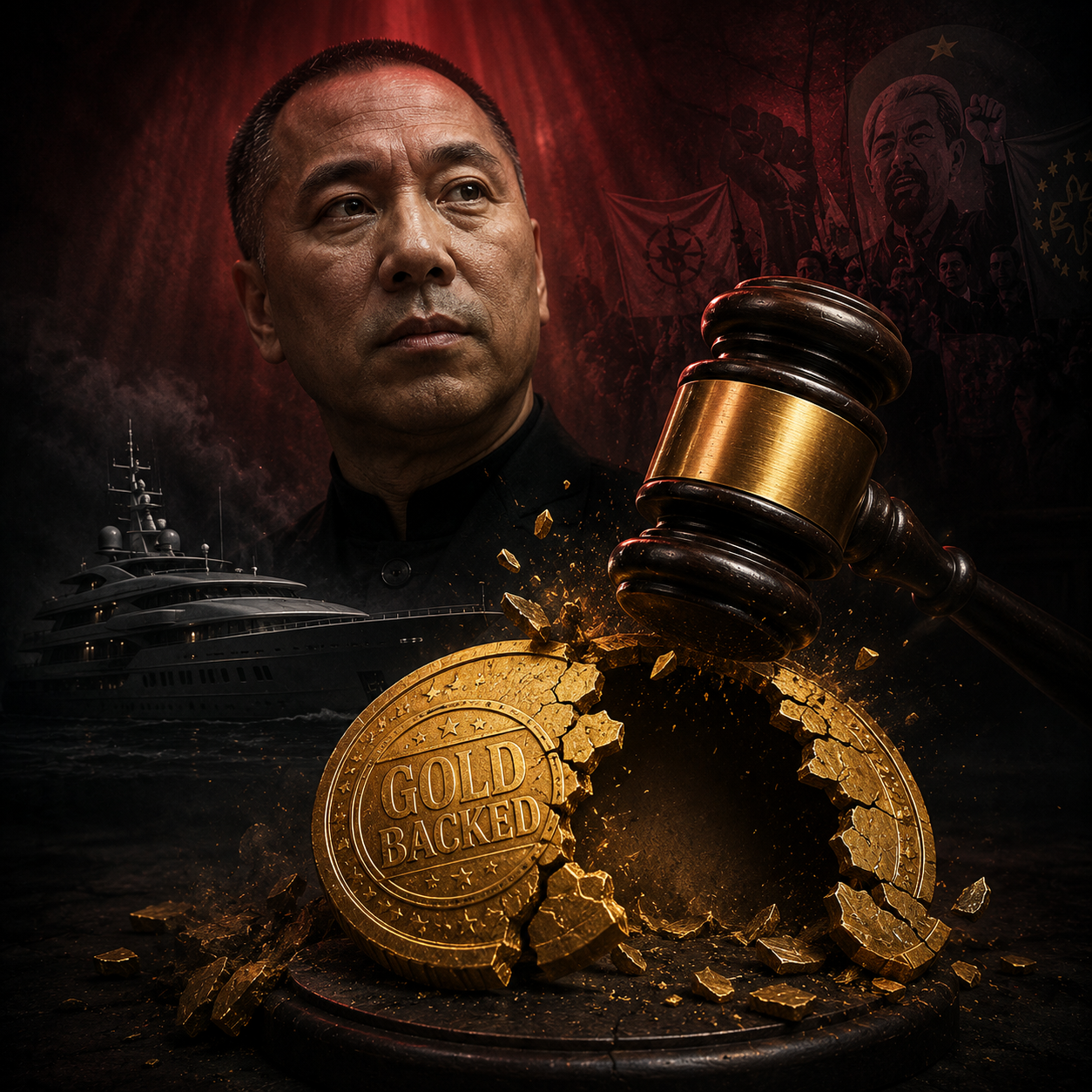
Guo Wengui built an audience before he built the fraud. That was the whole trick.
He fled China around 2015 and reinvented himself in New York as a loud, self-exiled critic of the Chinese Communist Party. He went by Miles Guo, Miles Kwok, Ho Wan Kwok, and a stack of other names. He lived in a penthouse overlooking Central Park and built a massive online following, mostly among overseas Chinese communities who believed he was one of them - a whistleblower with inside knowledge of Beijing's corruption, willing to say what they could not.
That trust was the product. Everything after it was the con.
Between 2018 and 2023, Guo convinced hundreds of thousands of followers to hand over more than $1 billion. He ran it through a web of entities he controlled: GTV Media Group, the Himalaya Farm Alliance, a membership club called G|CLUBS, and the piece that puts him on this list - the Himalaya Exchange and its crypto token, H-Coin.
The Himalaya Exchange pulled in more than $262 million on its own. H-Coin, also marketed as Himalaya Coin, was the pitch. Guo told buyers it was 20% backed by gold. He told them the operation would cover 100% of any investment losses. Both claims were fiction. It was a textbook affinity fraud: build an ideologically tight community, make yourself its hero, then sell that community a financial product too good to question. The people who trusted him most did the least due diligence. That was not a bug. That was the target.
The money did not go to any revolution. It went to a 152-foot superyacht. A penthouse at the Sherry-Netherland on Fifth Avenue. A mansion. Luxury cars. Investigators say those assets were bought directly with victim funds. The man raising money to fight tyranny was mostly financing his own address book.
Guo was arrested in March 2023. The SEC had already charged him and his financial advisor William Je that same month over H-Coin. In July 2024, a Manhattan jury convicted him on nine of twelve counts, including racketeering conspiracy, securities fraud, wire fraud, and money-laundering conspiracy. More than 1,000 victims worldwide were identified.
On June 29, 2026, US District Judge Analisa Torres sentenced him to 30 years in federal prison and ordered him to forfeit $889 million in restitution. The courtroom was packed with his supporters. Some of them still applauded him as he left.
Guo told the court his real purpose in coming to America was "to destroy the CCP." Judge Torres was not moved. She said he "preyed on those seeking to bring democracy to China," taking their money so he could live lavishly. Prosecutors called him "entirely unrepentant." One victim, Wei Chen, testified that Guo's fraud "destroyed my life" and her family's along with it.
The fraud needed a machine, not just a man. Guo's former chief of staff was separately sentenced to 10 years for the same billion-dollar scheme.
The political theater around Guo ran deep. He became close with former Trump White House strategist Steve Bannon - close enough that in 2020 the two announced a joint initiative aimed at the Chinese government, and Bannon was arrested on Guo's yacht that August in a separate, unrelated fraud case. Bannon was later pardoned in that matter. Guo also joined Mar-a-Lago and moved in well-connected circles. None of it saved him. The connections made headlines. The verdict did not care about them.
China had wanted Guo for years - he sat on an Interpol Red Notice at Beijing's request, which was part of what made him a folk hero to his followers in the first place. In the end it was not China that took him down. It was a New York jury, a US federal judge, and about 1,000 people who bet their savings on a man selling gold-backed crypto and a promise he never intended to keep.
Thirty years. Gold-backed by nothing.
The Aftermath
Guo Wengui was sentenced to 30 years in federal prison on June 29, 2026 and ordered to forfeit $889 million. His former chief of staff received a separate 10-year sentence for the same scheme. China's Ministry of Foreign Affairs noted the sentencing and reiterated that Guo remained a fugitive wanted on an Interpol Red Notice at Beijing's request. The case became one of the largest affinity-fraud prosecutions in recent US history and a marker of the DOJ and SEC treating crypto fraud with the same weight as traditional securities crime. For his followers, many of whom lost their savings, the restitution order represented a fraction of what disappeared into yachts, penthouses, and a revolution that never existed.
COMMENTS