The Government Won His Crypto in Court, He Just Moved It Anyway From Prison
A court ordered Rossen Iossifov to forfeit $290,000 in crypto to the United States. There was one problem the paperwork could not solve: the government had the order, but Iossifov still had the keys. So from inside a federal prison, he allegedly moved the money anyway.
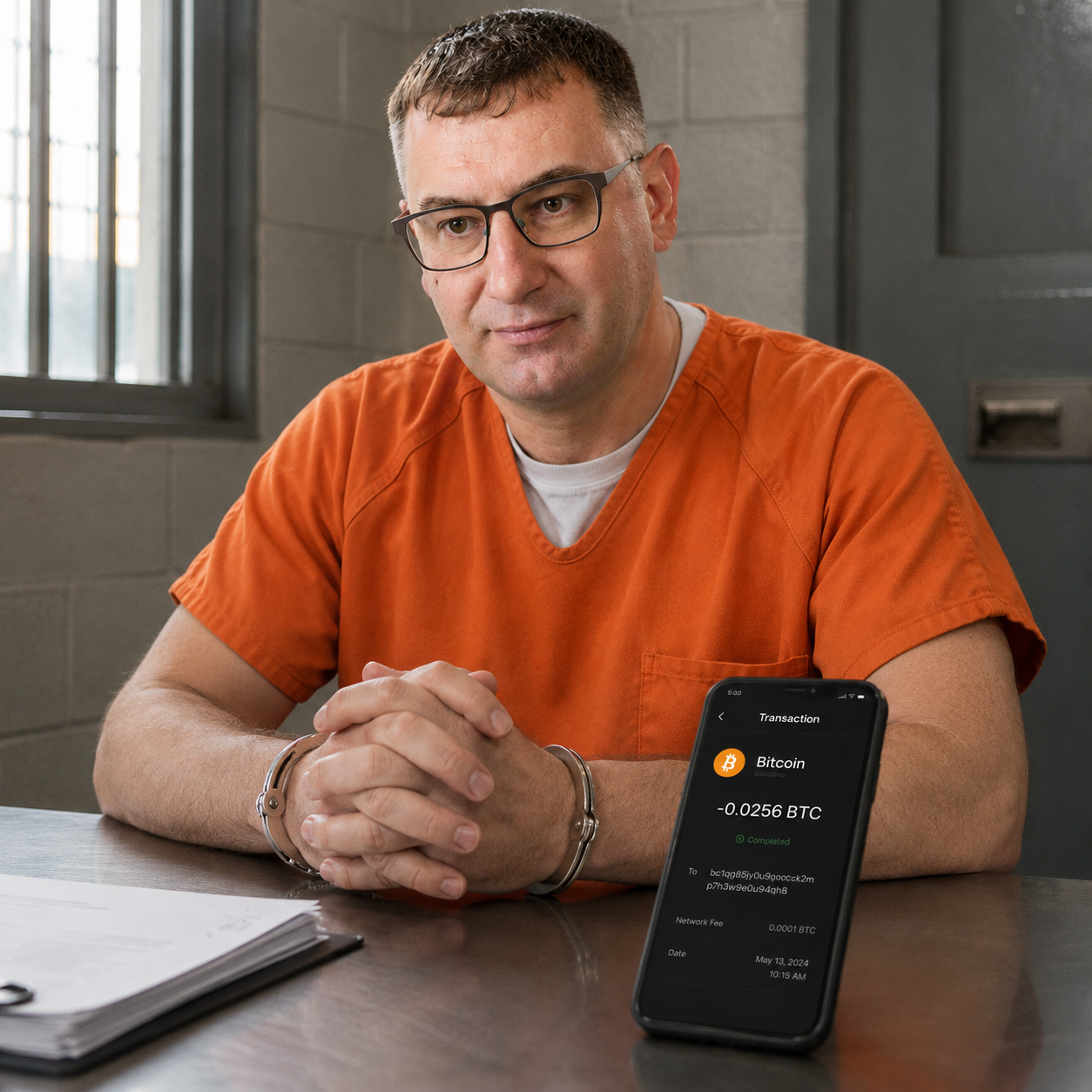
Here is a gap in the system nobody thinks about until someone falls through it. When a US court orders a criminal to forfeit cryptocurrency, the order is a piece of paper. It says the coins now belong to the government. But a court order is not a private key. Until federal agents actually take control of the wallet, the coins sit exactly where they were, and whoever holds the keys can still move them. Rossen Iossifov allegedly found that gap and drove a truck through it, from inside a prison cell.
Iossifov is not a first-timer. The 53-year-old Bulgarian national ran RG Coins, a Bitcoin exchange in Sofia that US prosecutors say functioned as the cash-out desk for the Alexandria Online Auction Fraud Network, one of the most prolific online scam rings ever charged. The scheme was simple and cruel. Members posted fake ads on Craigslist and eBay for expensive goods that did not exist, usually cars. They impersonated real sellers, sent professional-looking invoices, and collected payment for products they never had. US-based associates converted the stolen money to crypto and shipped it overseas, where Iossifov laundered it. Court evidence showed he moved nearly $5 million in under three years and personally pocketed more than $184,000 in the process.
He was convicted in 2021 in the Eastern District of Kentucky and sentenced to 111 months - a little over nine years. The court also ordered him to pay more than $2.6 million in restitution to his victims, and it imposed a forfeiture judgment: he had to hand over the cryptocurrency he had earned from the crime, roughly $290,000 worth, held in an account registered to him at the Kraken exchange. Conviction upheld on appeal. Case closed. The government had won the coins.
Except winning them on paper and possessing them are two different things.
According to a Justice Department statement on July 9, 2026, Iossifov conspired in January 2024 - while serving his sentence - to withdraw and transfer that forfeited crypto out of the Kraken account before the government could take control of it. Prosecutors say he moved the funds through multiple cryptocurrency exchanges and illicit mixing services, the standard laundering playbook, this time aimed at the very assets a judge had already awarded to the United States. He was in prison the entire time. The keys, apparently, were not.
The new charges are serious: destruction or removal of property to prevent seizure, aiding and abetting, and conspiracy to commit money laundering. Together they carry up to 25 additional years. For a man already nine years into a sentence, that is a stunning amount of extra exposure to take on for $290,000 - a fraction of what he had already laundered. But that math is the whole point of the story. The Secret Service, which ran the investigation, did not mince words. Special Agent in Charge Robert Holman called it a deliberate attempt to remove lawfully seized funds and a blatant disregard for the victims' rights. Those victims, more than 900 of them, were still owed $2.6 million in restitution. The $290,000 that allegedly walked out of that Kraken account was money that could have gone toward paying them back.
The case is quietly important beyond the audacity of it, because it exposes a real operational weakness in how the government seizes crypto. A forfeiture order is a legal event. Taking custody of a wallet is a technical one. In between those two moments - which can be separated by months - anyone with the keys can still spend the money. The DOJ noted the lesson plainly: for future seizures, agencies need to pair the court's authority with an immediate transfer into a wallet the government actually controls. You cannot forfeit what you cannot hold. Iossifov, if prosecutors are right, understood that better than the system that convicted him.
There is a grim efficiency to it. He is presumed innocent on the new charges, and an indictment is only an allegation. But the picture prosecutors paint is of a man who, already locked up for laundering, looked at the crypto the court had taken from him, realized the government had not actually grabbed it yet, and reached out one more time from behind bars to move it beyond reach. Most criminals try to hide money before they are caught. This one allegedly did it after the verdict, after the sentence, after the appeal, from a cell. The coins were the government's. He just still had the password.
The Aftermath
Iossifov appeared in federal court in the Eastern District of Kentucky in July 2026 and remained presumed innocent on the new charges, which carry a combined maximum of up to 25 years. The case drew attention as a demonstration of a structural weakness in crypto asset forfeiture: a court's forfeiture order can precede the government's actual technical control of a wallet by months, during which anyone holding the keys can still move the funds. The DOJ signaled that future seizures should pair court authority with an immediate transfer into a government-controlled wallet. The roughly $290,000 at issue was money that could have gone toward the $2.6 million still owed to the 900-plus victims of Iossifov's original fraud.
COMMENTS