Arthur Hayes: 'Meow - $HYPE to $150.' Sold Four Days Later.
On May 22 he called HYPE, ZEC, and NEAR his Holy Trinity. On May 30 he posted HYPE to $150 with a cat meme. On June 4 he dumped everything. ZachXBT called it exit liquidity. Hayes called it good trading. The people who bought the thesis and did not sell know who was right.
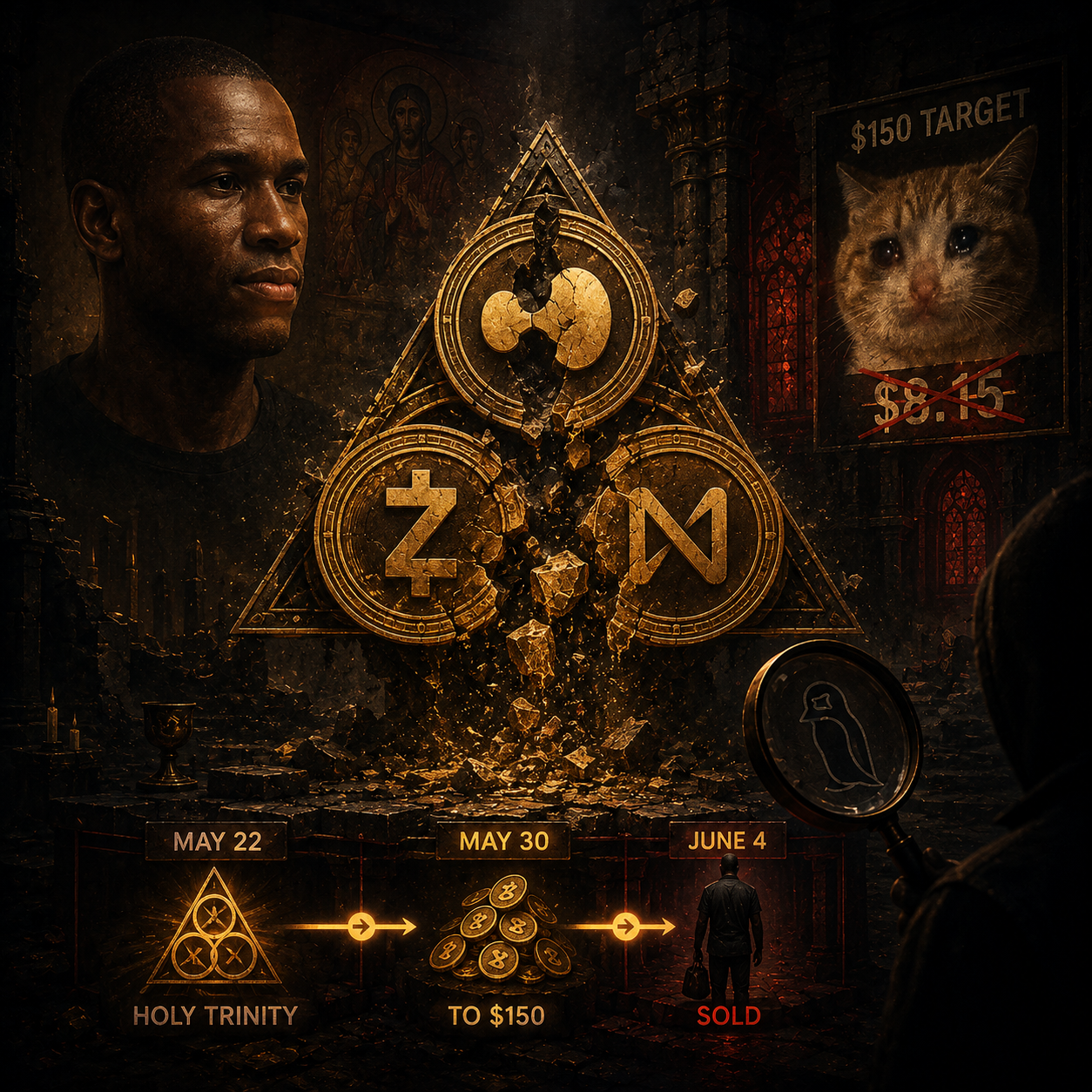
On May 22, 2026, Arthur Hayes named three tokens his Holy Trinity. On June 6, ZachXBT named it something else.
Arthur Hayes is the co-founder of BitMEX, the derivatives exchange that defined leveraged crypto trading in the 2010s. He now runs Maelstrom, a crypto venture fund. When he publishes a trade thesis, retail follows. He has spent a decade building that effect.
On May 22, the thesis was this: HYPE, ZEC, and NEAR. Hyperliquid's token for on-chain trading, Zcash for privacy, NEAR Protocol for AI infrastructure. He had already accumulated 247,334 HYPE tokens worth $10.44 million, built by rotating out of earlier PENDLE and ENA positions. He made a $100,000 charity bet with Multicoin Capital's Kyle Samani that HYPE would outperform every top-10 cryptocurrency by year-end.
On May 30, with retail still building positions on his thesis, Hayes posted: "Meow - $HYPE to $150." He included a cat meme.
On June 4, Hayes posted again: "I just dumped my entire $HYPE and $NEAR position." His reasons: rising energy prices from the Iran conflict, three upcoming mega AI IPOs, a prediction that Trump would turn anti-AI before midterms. He promised a full explanation in an essay called "Reality Test" the following week. HYPE dropped immediately. NEAR dropped 20% in a single session.
June 5: Hayes dumped ZEC after the Zcash Orchard bug went public. June 6: He dumped Worldcoin. Maelstrom had published a bullish WLD thesis three days earlier with a $5 price target by August. The fund that wrote the thesis sold within 72 hours of publishing it.
Four tokens. Four exits. Twelve days.
ZachXBT posted on June 6, making the pattern explicit. He called it exit liquidity. He documented the WLD case specifically and noted that Hayes had run similar sequences around ETH, PEPE, and ENA positions in 2025. Promote publicly, accumulate quietly, generate retail interest, sell into the demand.
Hayes responded the same day: "Sold to a willing seller at a price. Prices could just as easily have gone higher. I happened to call it right this time."
On June 9, Reality Test arrived on Substack. It was a serious macro essay. The central argument: AI absorbed the liquidity that should have flowed to crypto. Hayes calculated that hyperscalers and AI infrastructure companies had issued approximately $1.5 trillion in debt between November 2022 and mid-2026, matching almost exactly the $1.5 trillion rise in M2 over the same period. The money went to Nvidia, not to Bitcoin. That is why his altcoin trades did not perform as expected.
His current positioning: holding Bitcoin, potentially taking tactical short positions with derivatives. ETH is "dead but functional." High-beta altcoins are finished until the AI trade unwinds.
The macro argument holds up. The essay is worth reading. That is not the dispute.
The dispute is the four-day gap between "HYPE to $150" and full exit. The 72-hour gap between the Maelstrom WLD thesis and the WLD dump. At every exit, retail holders who bought the thesis were still holding when Hayes was already out.
Those people bought the Holy Trinity. Hayes sold it.
The $100,000 charity bet with Kyle Samani remains publicly unsettled.
The Aftermath
Reality Test published June 9-10, 2026. Hayes's macro framework - AI absorbing crypto liquidity - became one of the most discussed essays in crypto that week. Hayes holds Bitcoin and US energy stocks. All four altcoin positions are fully exited. The $100K charity bet with Kyle Samani is unsettled. Retail holders of HYPE, NEAR, ZEC, and WLD who followed the Holy Trinity thesis are sitting on significant losses. ZachXBT's exit liquidity accusation remains the defining controversy.
COMMENTS